


Seditionaries: Kitty’s Story
Updated: Aug 8
Kitty is a fictional character. The others are all real life historical figures in 1790s Belfast. This is a wee story I wrote about the streets around our shop on Skipper Street, set in late summer 1792, based on the history of the area. This story accompanies our Seditionaries collection… art prints, T-shirts, bombers, scarves.
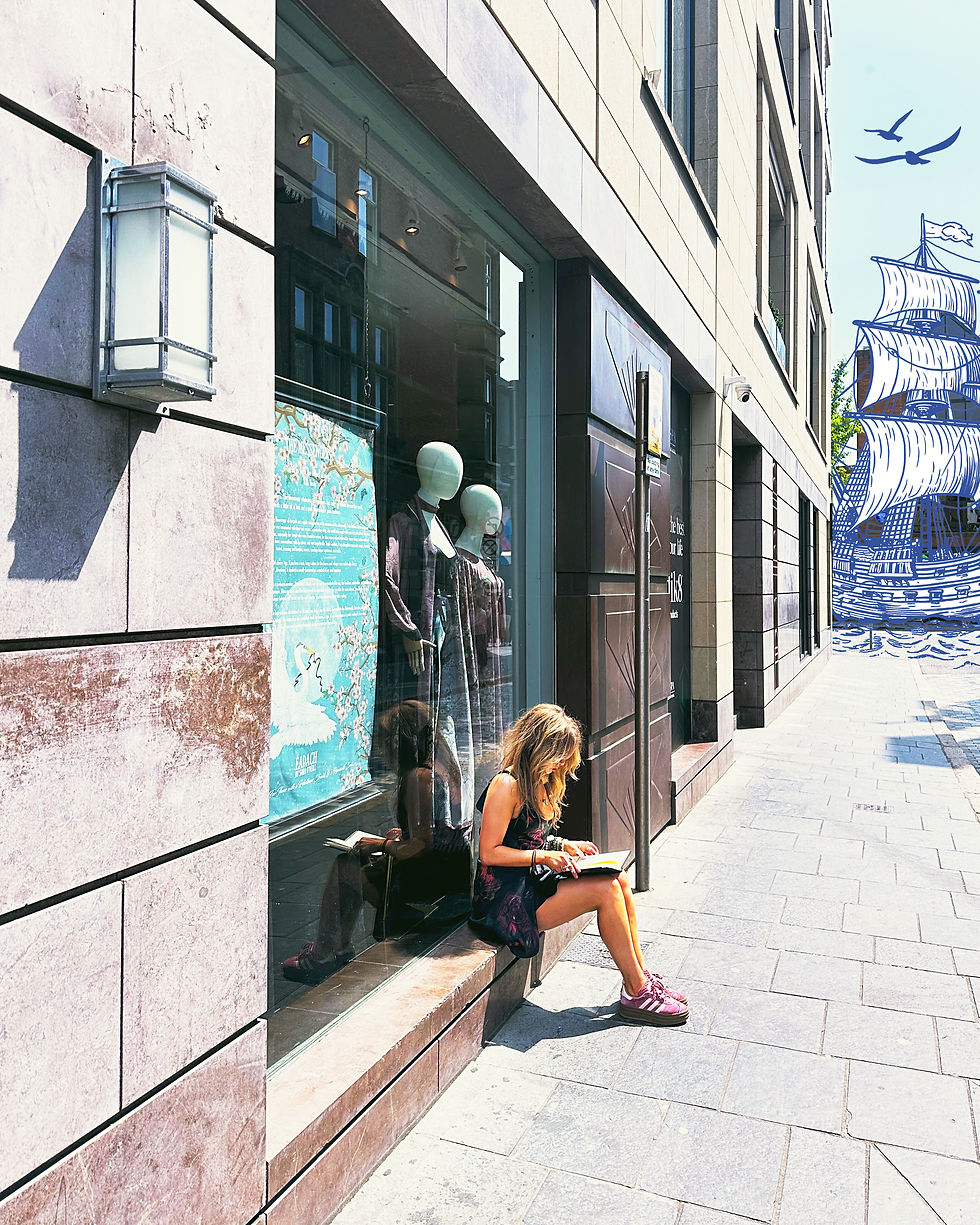
Kitty was woken, as usual, by the sounds of the Farset at the end of the street. Seagulls squalking, dockers shouting, barrels unloaded onto cobbles, the creak of the ships and underpinning it all, the rush of the river that flowed through Belfast from Squires Hill through Ballysillan, across the Crumlin Road, through the Shankill & Falls, Millfield, by the ruins of Belfast Castle, onto High Street where it passes Skipper Street where Kitty lives with her family above their tavern, the Crow’s Nest.

To be honest it hadn’t been a great night’s sleep anyway, not with Kitty’s new ‘do, courtesy of Bourdet on High St. He was Belfast’s most fashionable hairdresser, his father had been captured from Thurot’s forces in Carrickfergus in 1760 & although he was a Belfast boy he prided himself on keeping up with the French styles. For Kitty he’d created a Marie-Antoinette style ‘do, inspired by her iconic Pouf à la Belle Poule by Léonard. In 1778, during the American War of Independence, the French frigate La Belle Poule defeated a British ship, HMS Arethusa. The victory was hugely symbolic: it boosted French pride and signaled France’s growing challenge to British naval dominance. By wearing it, the Queen publicly celebrated France’s success, aligned herself with national pride and military strength and showed support for France’s involvement in the American cause. Although Kitty had supported the French Revolution, she still admired Marie-Antoinette’s fashion with a side of politics. To that end, she was in love with her new frock of striped linen she’d purchased at Mary Ann & Margaret McCracken’s shop on Waring Street, which she’d emblazoned with the slogan ‘Liberté, Egalité, Sororité’. (As I write this I’m sitting in the cocktail bar in the Merchant Hotel, in the space I believe Mary Ann & Margaret’s shop was, 37 Waring Street- Sara)

She got up and went about her day. Breakfast, a few chores in the tavern then out and about on errands. She bumped into Peggy Barclay who relayed her with all the news from the previous night in her own premises, Crown Tavern in Crown Entry just across the Farset at the other end of High Street. It seems Wolfe Tone, Henry Joy McCracken & Samuel Neilson had been in & were much the worse for wear, with Tone thumping the table and shouting ‘Huzza!’ repeatedly. Their Society of United Irishmen had formed in the tavern the previous year. They then went across to the docks to see the McCracken’s new ship, Hibernia, where they roared at him for having an ‘English Crown on her shield’.
The town was still buzzin with chat of the recent Harp Festival which had taken place in the Assembly Rooms. A group of local merchants organised the festival to revive interest in the ancient Irish art of harp music. Edward Bunting, the organist at St George’s Church, was commissioned to make a record of the music. The festival had gone down well with most people, although Wolfe Tone had complained that seven of the ten players were ‘execrable’ on the first day, stating ‘No new musical discovery; believe all the good Irish airs are already written.’ and returning on the third day of the festival said ‘Strum, Strum & be hanged.’ Although the McCrackens said it was great and everyone else seemed to enjoy it so Kitty suspected Tone was just a little worst for wear those days.

Kitty made her way across the four corners past the Assembly Rooms to Thomas McCabe’s shop on North Street. Thomas was a friend of her Da’s, a gold smith and watch maker & a founding member of the United Irishmen. He was well respected & liked in the town for his contribution to civic life. Along with Robert Joy & Captain McCracken, he financed the town’s first cotton-spinning machinery which was installed in the Clifton Poor House to teach the women & children a skill. This proved so successful that they opened the first water powered mill in Ireland for Cotton Spinning in 1784 on the Falls Road, powered by the Farset & now over 8000 people were employed as cotton spinners. What Thomas was most well known for though was an impassioned speech he’d given in the Assembly Rooms back in 1786. Waddell Cunningham, chairman of the Belfast Chamber of Commerce, had proposed the formation of a slave ship company operating out of Belfast. Cunningham held a meeting in the Assembly Rooms, to drum up support and finance for his shipping company. Thomas McCabe walked the short distance from his shop in North Street to join the meeting, where he declared… ‘May God wither the hand and consign the name to eternal infamy of the man who signs that document.’ Cunningham’s venture was thwarted and Belfast remained one of the few port towns in these islands to refrain from heavy involvement in the slave trade, with the United Irishmen & Mary Ann McCracken proud & vocal abolitionists.

She entered the shop, where she was to collect her father’s watch after a small repair. Thomas’s son, William Putnam McCabe, was there reading the latest edition of the Northern Star, the United Irishmen’s newspaper, which had been dropped in by the founder of the paper, Samuel Neilson, on his walk from the newspaper office in Wilson’s Court to his drapery shop ‘The Irish Woolen Warehouse’, just across the way on the Four Corners. William showed Kitty a review of Mary Wollstonecraft’s recent publication ‘The Rights of Women’ and she made a mental note to ask Thomas Russell of the Belfast Reading Society if they had a copy ot this book. She was loathe to spend her money at John Hughes’ on Bridge Street, she really didn’t like him although she couldn’t put her finger on why.
Speaking of people she didn’t like, she saw Belle Martin heading to work at Peggy Barclay’s other tavern in Sugarhouse Entry as she headed to Berwick & Co on Foundry Lane to pick up some tea. On the way back she stopped by Mary Ann & Margaret McCracken’s textile shop on Waring Street for a chat with Mary Ann. She was such an intelligent, informed & thoughtful woman. She had attended the school of David Manson, the progressive educationalist, on Donegall Street and the McCracken family were key in the establishment of the Belfast Charitable Society. As she left she bumped into her father exiting Frank McCracken’s rope shop next door. They walked back to the tavern together discussing the news they’d gathered on their respective journeys and Kitty contemplated how content she was to live in a town of so many radical thinkers, of progressive ideas… feminism, equality, freedom, education, anti-sectarianism, abolitionism. A town with so much energy & divilment.
The following year the Society of United Irishmen was banned by the British Government & driven underground. In the same year the sign of the Northern Star office was pulled down and the windows smashed by a military mob.
Four years later the British General, Gerard Lake arrived in Béal Feirste. He was appointed commander of the Crown Forces of Ulster in 1797, and Commander-in-Chief of Ireland in April 1798. He enforced brutal martial law in Ireland in 1797 & used violent tactics to attempt to control. His sweeping military powers and curfews directly preceded and escalated into the 1798 Irish Rebellion.
He said of Belfast.. ‘All acts of sedition originate in this town. Nothing but terror will keep them in order’. (Some things never change)
On July 17, 1798 Henry Joy McCracken was court martialed in the Assembly Rooms and taken to the Market House where he was executed. It broke Kitty’s heart to watch his sister Mary Ann accompany him to his death. His last words were to her, "Tell Russell I did my duty".
Five years later Thomas Russell, the librarian, would meet the same fate. Convicted of high treason in Downpatrick, on 12 October Russell was hanged and beheaded. His remains were buried in the graveyard of St Margaret's Church, Downpatrick, a grave paid for by his friend Mary Ann McCracken. Kitty heard that Mary Ann had assisted both men when they were on the run, and admired her all the more for it.
At 59, Thomas McCabe was too old to fight in the rebellion but meetings to plan the Battle of Antrim were held at his house. During and after the insurrection, his shop in North St was repeatedly attacked by government troops. His son, Kitty’s pal William Putnam McCabe, acted as bodyguard to Lord Edward before his capture, and escaped to France after the revolution. He worked to assist Robert Emmet in coordinating a new rising in Ireland in 1803.
Samuel Neilson had been arrested and imprisoned in May 1798 whilst carrying out a recce with the aim of freeing Lord Edward Fitzgerald from Newgate prison in Dublin. He was accused of high treason and held in Kilmainham Jail. He was transferred to Port George in Scotland then deported to the Netherlands. From there he travelled to America, arriving in 1802. He was preparing to revive the Northern Star and bring his family over from Ireland but died suddenly in Poughkeepsie in 1803. His widow, Nancy, had remained in Belfast. Fearing persecution in the aftermath of Emmet’s failed rebellion she sent Neilson's letters and copies of the Northern Star to a pal in New York. After her death Neilson's son requested the return of these documents. They were put aboard the Shannon, a ship bound for Belfast, which was wrecked off the coast of Donegal with the loss of all souls and cargo.
Theobald Wolfe Tone was in exile in France when the Rebellion broke out. In October of 1798, he attempted to return to Ireland and was on the French ship Hoche when they encountered a British squadron in Lough Swilly at Buncrana. During the Battle of Tory Island the ship was struck. Two weeks later, held in the privy quarters of Lord Cavan in Letterkenny, he was recognised by MP & leading member of the new fraternal Protestant organisation, the Orange Order, Sir George Hill and he was arrested. He was court martialed in Dublin on the 8 November. His one request was as a ranking French officer, he might ‘die the death of a soldier’ and be shot. The request was denied, he was found guilty of treason & condemned to hang on the 12th. On the morning of his planned execution he was found in his cell with a wound to his throat, an apparent attempt to take his own life. He died a week later.
Mary Ann lived til 1866, to the age of 96. She dedicated her life to vital social causes. From a young age she owned her business with her sister and even during downturns in the business in the early 19th century, they refused to cut costs at the expense of her (female) employees. She was fascinated by industrial advances in the textile industry, hoping for a future in mechanisation would afford workers the energy and time for greater education and leisure. She dedicated herself to practical work at Belfast Charitable Society at Clifton House. She was passionate about equality for women and education for children. Wearing the famous Wedgewood brooch adorned with the image of a bound enslaved person and the words "Am I not a man and brother" Mary Ann boycotted sugar and became a lifelong active abolitionist. Following Frederick Douglass’s visit to Belfast in 1845 McCracken helped establish the Ladies Anti-Slavery Association.
After her brother’s execution in 1798, Mary Ann had discovered he had a four year old daughter, Maria. She raised her niece as ‘an only affectionate daughter’ and they lived, along with Margaret, in 62 Donegall Pass. In Mary Ann’s old age, Maria took her into her family home, where she died and was buried at Clifton House. A woman Belfast should truly be proud of.
And to finish where we began, with the river Farset. By the early 19th century the Farset resembled an open sewer. Industry had grown along the banks of the Farset, mills & factories powered by the water. Corn mills, foundries, distilleries, bleaching greens and the linen and cotton mills that turned Belfast from a town into a booming industrial city. Merchants traded, their ships bringing goods in and out of the heart of the town through the Farset. Linen, rope, butter, meat, fish, corn, hides and tallow were exported, whilst sugar, tobacco, rum, spices, tea, coffee, fruit & wine were imported.

Unfortunately the growing population & industry meant the river became a dumping ground, polluted and stinkin. The slaughter houses & butchers (all 47 of them) of Hercules Street (now Royal Avenue) disposed of animal waste and carcasses in the river. Between the 18th and 19th centuries the river became culverted & by 1848 it was completely covered. It now flows in a tunnel a mere 60cm below our feet as we go about our business in those parts of the city. Unseen but ever present, tangible.
Much like the Farset, the stories of the United Irishmen, Mary Ann McCracken & Belfast’s radical history seems to have been buried somewhat. Too inconvenient for the prevailing ‘two sides’ narrative that has encouraged division for so long. These men & women don’t fit neatly into the boxes that were created for the people of Ulster, then Northern Ireland. But great stories never die. And just as we walk over the river every day, so too do we walk in the footsteps of our characters of 1790s Belfast. For too long, largely forgotten & ignored. How many times have you passed Dunnes in High St? That’s where the Market House was located, where Henry Joy McCracken was executed. The Assembly Rooms at the end of North St and Donegall St, lying derelict for far too long, was where he was court martialed and where the Harp Festival of 1792 took place. Mary Ann’s shop was on the site that is now the Merchant Hotel. The Entries that housed the Northern Star newspaper and the Crown Tavern where the society was founded, are slowly coming back to life. Sugarhouse Entry was recently reopened after many years of being closed off. We walk by these places every day, and thanks to a small dedicated group of history nerds, these stories have resurfaced. I was present when Mary Ann’s statue was unveiled in the grounds of City Hall a couple of years ago, a much more emotional event than I expected. Growing up here, statues were often related to Empire and nothing I connected to. Passing Mary Ann every day is incredibly special. A statue of Frederick Douglass was unveiled in Rosemary St.
All this a reminder of the radical, progressive ambitions of a group of people in Belfast over 200 years ago whose time has perhaps finally come.


Comments