


An Interview with Sara O'Neill: Part 1. Megan Fox Interviews Sara for Irish Country Magazine.
Updated: May 20
How would you describe Éadach?
“Storytelling in silk, linen & leather. Limited edition hand drawn prints inspired by Irish folklore, women & history, for those with a rebellious streak and romantic soul.” is my official description. Unofficially, they are ‘my scribbles’.

You are so much more than just a designer. In the past you have also been a stylist and clearly have an eye for seeking out amazing vintage and unique pieces to add to your own wardrobe. Tell us a little about life before being a designer and how this has impacted the way you design?
I wanted to be a designer from a very young age, although we didn’t know anyone in the fashion industry so it was a bit of a random one and seems very unrealistic.

I was a creative, shy kid & as I progressed into my teens I started experimenting with my own style, had to make a lot of my own clothes or customise second hand stuff because the things I wanted to wear weren’t available in the 90s, not here anyway. I’d save up waitressing money & go mad in the shops in Temple Bar when I’d visit family in Dublin. My appearance attracted a lot of attention, quite a lot of that was negative actually and I realised the power image had to provoke emotion & feelings, good & bad.

It was a really powerful language, which I found fascinating. I went to the Ulster University in Belfast 2000-04, got a BA Hons in Fashion & Textiles. I didn’t love it so didn’t want to be a designer by the time I graduated. After uni, I was waitressing & still looked quite outrageous, which caught the eye of a photographer in the restaurant I worked in. We got chatting & he asked me to style a shoot for a magazine.. this was 2006-ish. I wasn’t sure what being a stylist entailed, but he put me in touch with some boutiques, I dressed as nicely as I could (no ripped fishnets) and god love the shop owners, they let me borrow stuff. The shoot was cool, but kinda risqué for the time. It got some complaints, my name got out there and I started working with other photographers, got booked by ad agencies, other mags, fashion shows. I had very free rein for a few years and I liked to promote charity shop stuff (I was an ambassador for Oxfam for many years), student & graduate work, independent boutiques.

There were a lot of events to go to, a lot of in person networking to be done back then as a freelancer. When the crash happened in 2008 and in the years that followed magazines became more precious about the kind of clothes I could use in a shoot and wanted me to promote their advertisers more, which may not have been the kind of aesthetic I was after. I did a lot of ad campaigns around that time because people really wanted to advertise.
The next big change came with social media. I always enjoyed writing and would write columns for magazines & papers, with online growing I wrote a lot of content for ad agencies. The kind of work we did broadened out, it was no longer just about billboards & magazine ads, online imagery was a thing as well, and people loved ‘behind the scenes’ footage. Video became the next big thing in social media, with YouTube etc. I always enjoyed talking about fashion & found it easy to do so, so my clients wanted me to come out from behind the camera and be in front. I enjoyed this to a certain extent but I missed the creativity & storytelling aspect of just creating imagery and I didn’t want to be an influencer.


One of my favourite things to do in life since I was little was draw but after university I let that slide, until around 2011. Back then I got a solo exhibition booked in which pretty much sold out before it opened. After that, I signed with an illustration agency in London & NYC, had another couple of exhibitions. So for years the art work was running alongside the styling work and I loved both. A big thing that happened was a health issue, I was diagnosed with Ménière’s disease in my late 20s. Being freelance with a shitty illness like that was really challenging and although I went into remission a few years later it kinda haunted me & that along with a few other life changes made me reassess my business model.
In 2014 I applied to the Arts Council NI & received their Creative Industries Innovation Fund. I wanted to use it to combine both sides of my business.. art & fashion. The same year I moved from Belfast back to the north coast and it was being there that brought back the stories my granny had told me as a child.

So I started to illustrate them, pencil drawings which I digitised and added colour and would then get just a couple of metres printed up on silk in a little place on Sandy Row in Belfast. I started off just with scarves although I was really specific about the sizes..often on a shoot a piece of fabric would save the day, used in so many different ways when garments just didn’t work. So I wanted to take that idea of a really versatile piece of fabric that could be fashioned in various ways & that became the starting point of Éadach.

Your pieces are like wearable art. Aside from Irish history and story telling, what inspires your work in terms of colours, shapes etc. ?
Thank you! Every aspect of my prints is taken from some part of this island. That could be sunrises & sunsets, the colours of which dominated my early designs.

I was struggling at the beginning to bring colour to the pencil drawings to make a beautiful print that could be worn.

I was styling a shoot for Grazia one day, we were shooting in the Cathedral Quarter in Belfast and outside the Duke of York pub I glanced up I saw Yeats’ ‘embroidered cloths’ on the wall and it came to me… I should use the colours of the sky, the amazing sunrises & sunsets we have on the coast.

In recent years, colours and motifs might come from architecture, in The Dreamer print for example, from the Art Deco buildings of Belfast or in the Merrion print, the Georgian houses of Dublin. It could come from nature, the flora & fauna of hedgerows & forests. In terms of the shapes of the garments, I like to keep them simple to let the print, the movement of the fabric & the wearer be the focus.

You make the most incredible kimonos. What is it about this style that draws you in?
When I was a stylist I collected a LOT of vintage clothes. Rummaging around looking for stuff for shoots it was often ‘one for the shoot, one for me’. 1940s suits, 1950s dresses with full circle skirts & petticoats, early 60s brocade dresses, and vintage silk kimonos. I always loved that look, bohemian late 19th/early 20th style, more popularised in the 20s & 30s.
But when I moved to the north coast from Belfast in ‘14, much of my wardrobe just didn’t work. I went from living in a city, going to events & gigs all the time, to bumming about the beach & cliff top. I felt a bit lost style-wise, wore a lot of jeans, jumpers & tshirts which was practical but not really me. Party dresses and heels on the beach look kinda silly, I don’t advise it. The vintage kimonos still worked though. So in 2016 I started messing around at the kitchen table with silk, with an idea of a kimono cut from one piece at the back, with the wings of the new Lost Soul print spanning the shoulders & arms. And it looked pretty feckin class.

I was very relieved a few weeks later to receive a message from Lorraine who had been the sewing technician in UU (who I avoided as a student because I never had my work done) Fortunately she was willing to overlook my bad student habits & she started making the kimonos, so I could go back to the drawing and designing. And now we have some other amazing women making them locally. I love these pieces for many reasons. From a print perspective, they are perfect as there are no darts and few seams to get in the way of the artwork.

From a sustainability perspective there is little waste with the kimonos and none on the capes. We save and use what cut offs we have. From a lifestyle perspective, for me they were the thing I could throw over jeans for the coast or dress up for going to the city.

From the wearer’s perspective, I want my customers to wear these pieces for many years. Bodies change size & shape over the years & I want the kimono to be the piece they can always throw on regardless. I love the movement of the garments, the drama, versatility & the comfort. We use antique buttons on the sleeves, the current batch is deadstock from the 1850s. I love that after almost 200 years they get to do the job they were made for.

In contrast a bomber jacket is a little more edgy. Yet you blend the two styles so well and all your pieces can be layered and worn so seamlessly together. Is this intentional?
When I lived in Belfast the punk scene was a huge part of my life, we were members of the Warzone Collective, we lived down the street and used to put up anyone passing through or anyone who was between homes, our flat was where everyone hung out. There’s a lot of that time that I’ve brought with me, certain ways of doing things, building community, giving back. On Saturday afternoons I’d come home from waitressing & the air would be thick with Shockwaves hairspray & smoke. Everyone getting ready for whatever gig was on that night & the style was epic. Mohawks, half-a-heads, pole spikes. Every colour. Head to toe customised gear.

So of course there’s quite a bit of the style that I’ve brought with me although this is not always immediately obvious. You may notice chains and padlocks through the Children of Lir print or barbed wire in the Róisín Dubh. Slogans, now often in Irish. Skulls. A few years back I decided to do a homage to my old punk jacket.

Everyone had much loved, second hand leather jackets that we’d stud and paint with our favourite bands, political slogans, artwork. Labours of love. I nicked the big pocket off a flatmate’s combats to sew into the lining of my jacket to smuggle a bottle into gigs. It was our street armour. I wanted to recreate those Éadach-style and I’ve done a few over the years.

But we tended to wear those jackets at weekends only, to gigs or if there was a crowd drinking on the streets. They were heavy because leather jackets always were then, and sometimes impractical so the rest of the time we wore bomber jackets or Harringtons. And that’s where the idea for the Éadach bomber came from.
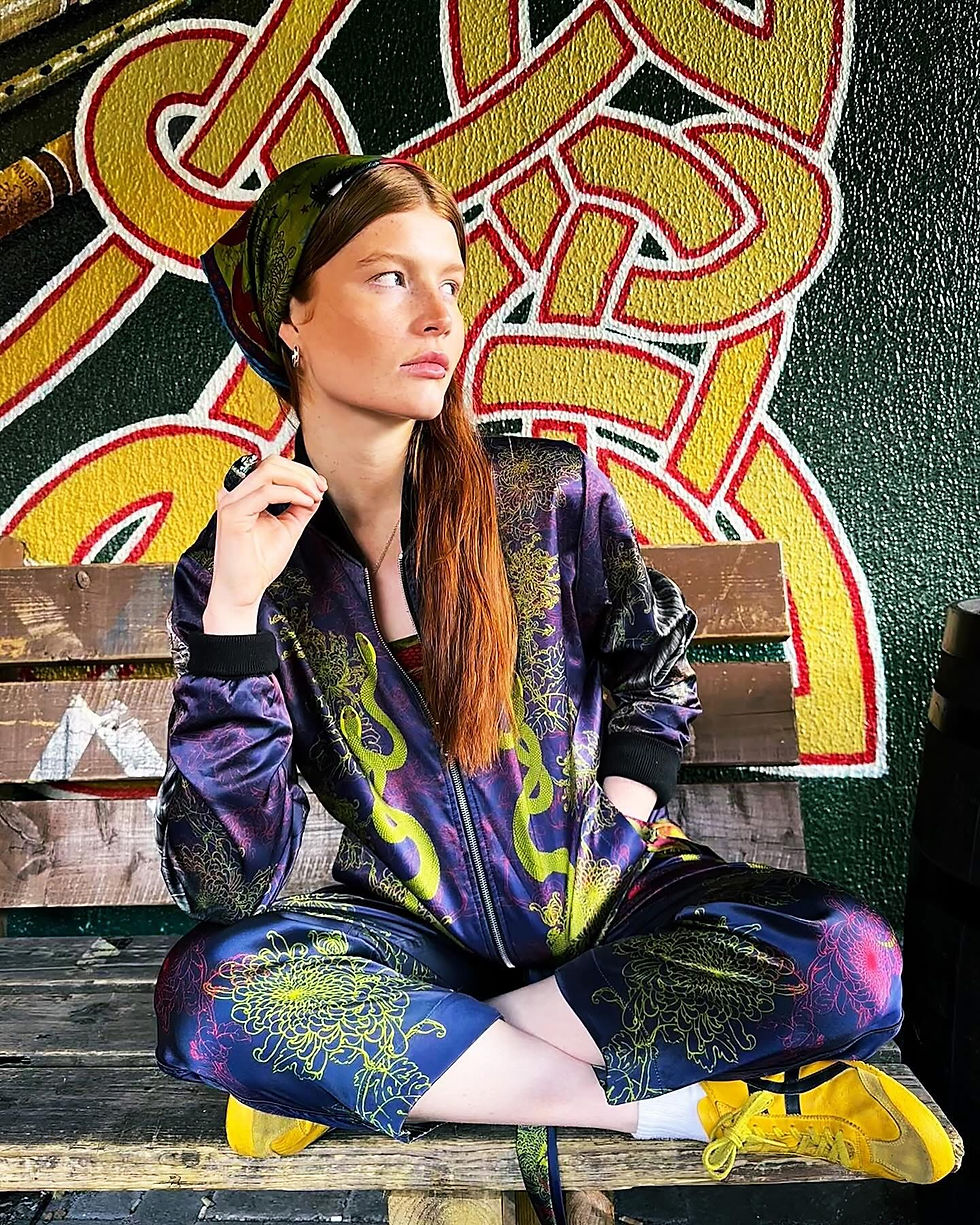
They are unisex & reversible, one side silk, the other cotton, with different prints on each side so it kinda feels like two jackets (good if you’re a spiller). I tend to layer Éadach pieces up, often in the same print head to toe, the kimono under the bomber creates an interesting silhouette & movement. I wear the Róisín Dubh print a lot because I love black. I have an Éadach colour palette I use, so I’ll use the same shade of pink for example through various prints so they can be mixed and matched in a way that it kinda clashes but works.

For me a designer is a problem solver and fashion isn’t rocket science but we all wear clothes every day so I want to solve some of the problems my customers have. The best way I can do that is by designing hard working, versatile pieces that they love and wear a lot. I’m not into trends, sometimes by accident my pieces might fit into a trend, but I’ve always had way more fun doing my own subcultural thing with clothes so that’s what I channel into Éadach.
A pal was at an event recently wearing Éadach, was chatting to another woman wearing one of my pieces, when a third woman joined in saying she wears Éadach when she ‘needs an extra boost of confidence’. My pal said to me later ‘when you see someone else wearing Eadach you share a nod like knowing you’re part of the same gang. Like the way witches know each other.’ And I love that.



Comments